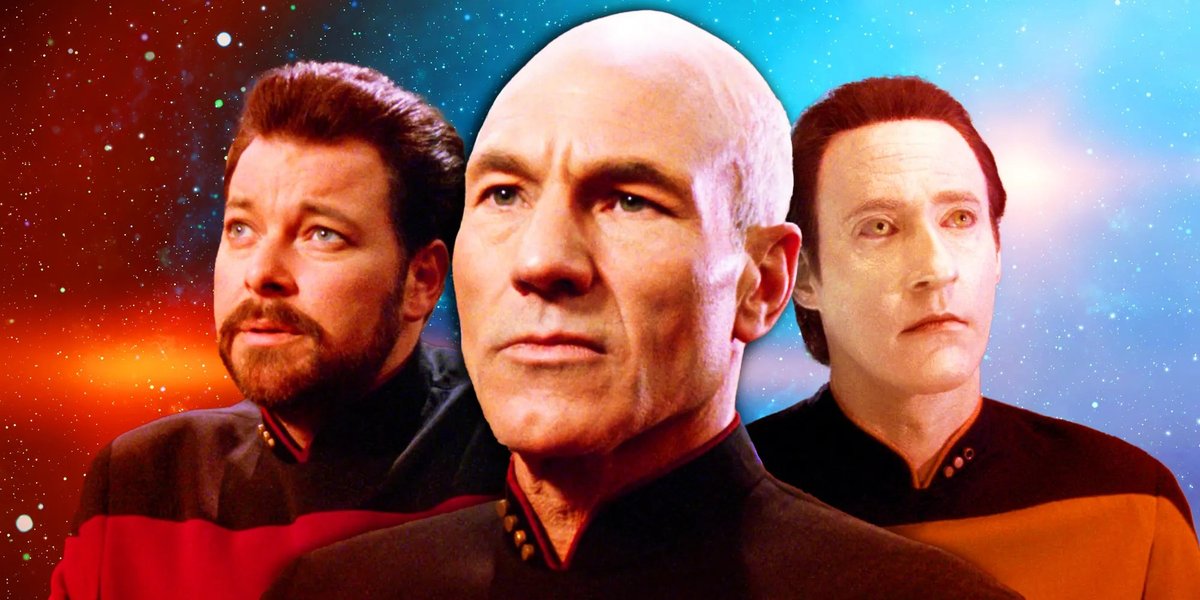
In a galaxy often defined by warp speed and phaser blasts, Star Trek: The Next Generation (TNG) stands out as something far more profound than just science fiction. It's a vibrant tapestry woven with deep themes & philosophical concepts, a veritable curriculum guide that invites us to ponder what it means to be human, to govern justly, and to strive for an ethical future. For 735 hours across its various iterations, Star Trek has provided a unique, evolving backdrop for philosophical inquiry, and TNG, in particular, honed this tradition into an art form. It's where the rubber meets the philosophical road, exploring complex ideas through the lives of Captain Jean-Luc Picard and his diverse crew.
At a Glance: TNG's Philosophical Frontiers
- Humanism as a Guiding Light: TNG champions reason, cooperation, and the dignity of all life, reflecting Gene Roddenberry's humanist vision for humanity's future.
- The Federation's Utopian Ideal: Explore the principles of a post-capitalist, Socratic democracy, emphasizing self-betterment over material wealth.
- Kantian Ethics in Command: Witness Picard's unwavering commitment to universal moral laws and duty, even when facing dire consequences.
- Defining Personhood: Delve into the complex questions of consciousness, self-awareness, and identity, most famously through the android Data.
- The Prime Directive's Moral Maze: Grapple with the ethical dilemmas of non-intervention and cultural sovereignty, and the limits of humanitarian impulse.
- Existential Journeys: Follow characters as they confront life's meaning, purpose, and the weight of their choices in a vast, often indifferent universe.
- The Evolution of Human Thought: Observe how TNG uses scientific principles and challenges us to move beyond simplistic good-vs-evil narratives.
Starfleet's Ethical Compass: Living the Humanist Dream
At its core, Star Trek: The Next Generation is a powerful testament to Humanism. Creator Gene Roddenberry, a proud member of the American Humanist Association, envisioned a 24th century where humanity had transcended its baser instincts. Racism, superstition, conflict, and poverty were banished. Instead, the UFP operated on voluntary cooperation, non-violent conflict resolution, and an unwavering dignity for all life. This is a future where reason and science are trusted, yet emotions, spirituality, and intuition are embraced—a vision where humanity relies on its own resources, echoing Nietzsche's assertion that "God is dead" by advocating self-reliance over supernatural intervention.
TNG’s Starfleet, as the exploration and defensive arm of the United Federation of Planets (UFP), embodies these ideals. The UFP, a liberal, post-capitalist, socialist utopian democracy, co-founded in 2161 AD, governs over 150 member planets. Money is obsolete, replaced by a collective pursuit of self-betterment, reflecting a Socratic model where knowledge and wisdom are paramount. Its motto, "Ex Astris Scientia" (from the stars, knowledge), perfectly encapsulates this drive for understanding.
The Weight of Duty: Kantian Deontology and Picard
One of the most profound philosophical underpinnings of the Federation, especially evident in Captain Picard's leadership, is Kantian Deontology. Immanuel Kant's Categorical Imperative, which posits universal moral laws based on duty and rational capacities, dictates that actions are performed from duty, with pure intentions, irrespective of consequences.
Picard consistently grapples with this. A prime example is "I, Borg" (TNG S5), where Starfleet considers using a unique, separated Borg drone—Hugh—as a biological weapon against the Collective. Picard, after interacting with Hugh and witnessing his burgeoning individuality, refuses to contaminate him. Despite the strategic advantage, he believes it would be a morally reprehensible act, treating a sentient being as a mere means to an end, violating Hugh's intrinsic worth. This choice, made from duty to a universal moral principle, regardless of the potential pragmatic benefit of wiping out the Borg, is pure Kantian ethics in action.
While Kantian deontology sets the moral boundaries, TNG also subtly layers in Aristotelian Virtue Ethics. Here, actions stem from rational control, seeking a "golden mean" between extremes. Virtuous acts are knowing, good, chosen, and consistent. Picard, Riker, and Data often demonstrate this, making decisions that balance courage with caution, justice with mercy, and loyalty with objective reason.
Defining "Life": The Data Conundrum
Perhaps no character in Star Trek: The Next Generation better exemplifies the exploration of consciousness, identity, and what it means to be alive than Lieutenant Commander Data. Data, an android striving for humanity, constantly pushes the boundaries of philosophy.
"The Measure of a Man": A Landmark Case
The iconic TNG episode "The Measure of a Man" (TNG S2) serves as a legal battleground for Mind-Body Dualism and Identity. Starfleet wishes to dismantle Data for study, claiming he is property. Picard defends Data, arguing he is a sentient being with rights. Through this courtroom drama, the series delves into fundamental questions:
- Consciousness: What constitutes awareness? Is it sentience, self-awareness, or the ability to feel emotions?
- Personhood: When does a collection of circuits and programming transcend to become a "person" with inherent rights?
- Identity: Drawing from John Locke's ideas, Data's continuous long-term memories, his unique personality, and his desire for self-improvement argue for his individual identity, much like Locke's "tabula rasa" (blank slate) concept for new minds evolving through experience. The episode powerfully asserts that Data is not merely a machine, but a unique individual deserving of protection.
While the concept of a "katra" (soul) is more explicitly explored in Vulcan physiology in Star Trek III: The Search for Spock, Data's struggles to understand and emulate human emotions provide a parallel inquiry into the non-physical aspects of identity and what makes a being "feel" truly alive. Even the instantaneous matter transporter, a staple of Star Trek, subtly challenges Lockean notions of identity—are you the same person if your atoms are reassembled elsewhere? TNG frequently revisits these puzzles without easy answers.
The Prime Directive: A Universal Moral Law with a Catch
Central to Starfleet's ethical code is the Prime Directive, a stricture forbidding interference with the natural development of less advanced civilizations. This isn't just a rule; it's a philosophy, a shield against disastrous interference and emotional judgment. Episodes like "Symbiosis" (TNG S4) vividly illustrate its challenges, where Picard must weigh providing medical aid against respecting a pre-warp society's reliance on a harmful drug trade, choosing non-intervention to protect their cultural sovereignty.
This aligns powerfully with Westphalian Peace (1648), which established political self-determination, legal equality between states, and non-intervention in internal affairs as cornerstones of international relations. The Prime Directive takes this global principle to an interstellar scale. Yet, it constantly presents agonizing dilemmas, as seen in "Insurrection" (TNG S9), where upholding it means withholding humanitarian aid from a displaced population.
The Prime Directive implicitly extends Regan's "Subjects-of-a-Life" and Respect Principle. Philosopher Tom Regan argued that Kantian ethics should extend beyond rational beings to all "subjects-of-a-life"—any being with intrinsic worth, who should never be treated as mere means to an end. TNG, with its vast array of alien life forms, often explores this principle, emphasizing respect for sentient beings regardless of their technological advancement or physical form.
Science, Reason, and the Quest for Knowledge
Star Trek: The Next Generation is fundamentally a celebration of Science and Empiricism. While it employs "technobabble" to navigate plot points, it consistently champions the scientific method, rational inquiry, and the belief that understanding the universe is humanity's highest calling.
The show draws from a rich lineage of philosophical thought regarding science:
- Democritus's atomistic thinking (matter comprised of discrete particles) forms the basis of many scientific principles explored, from replicators to transporters.
- Aristotle, the father of empirical science, laid the groundwork for the scientific method, stressing observation and evidence. His concept of teleology—purpose in behavior—can be seen in Starfleet's purposeful exploration.
- Francis Bacon championed planned experiments and inductive reasoning, principles Starfleet scientists like Data and Geordi La Forge apply daily.
- John Locke's idea that knowledge is a posteriori (based on experience) and imposed on a "tabula rasa" is lived out by Starfleet's exploratory mission, encountering new phenomena and building knowledge from observation.
- Even David Hume's skepticism, particularly regarding predicting the future from past events, finds echoes when Starfleet confronts unforeseen variables or anomalous phenomena.
- Galileo's assertion that mathematics is the language of the universe is a foundational belief, underpinning every warp core and subspace communication.
TNG often grounds its "god-like" beings not in mysticism, but in advanced science, aligning with Epicureanism and philosophers like Thales and Xenophanes who rejected anthropomorphic gods. Beings like Q, though immensely powerful, are never truly supernatural, but rather highly evolved entities operating on principles beyond human comprehension, reinforcing the idea that science can eventually explain anything.
The Human Condition: Existentialism, Empathy, and Identity
While some existentialist themes are more prominent in Deep Space Nine or Voyager, Star Trek: The Next Generation offers its own profound explorations of individual meaning, purpose, and the impact of choices in a vast, often indifferent cosmos.
Picard's experience in "The Inner Light" (TNG S5) is a masterclass in existential empathy. Through a mysterious probe, he lives an entire lifetime as Kamin on a doomed planet, experiencing love, family, and loss. This episode profoundly explores the human condition, the importance of memory, and the search for meaning, even when individual existence is fleeting. Picard's grief and newfound empathy upon his return highlight the unique burden and beauty of conscious experience.
Similarly, "Tapestry" (TNG S6) presents Picard with a chance, courtesy of Q, to change a past mistake that almost cost him his life. He chooses a less daring path and finds himself leading a less fulfilling, more bureaucratic life. This episode champions the idea that perceived mistakes and challenging experiences forge our identity and lead to personal growth. It's a powerful statement about how existence precedes essence—our choices and experiences define who we become, rather than some predetermined nature.
TNG also touches on Manichaeism and Dualism, presenting binary structural oppositions (good vs. evil, order vs. chaos). However, it often complicates this, showcasing antagonists like the Borg as less "evil" and more a force of nature, or Q as a mischievous, morally ambiguous entity, pushing the crew beyond simplistic binaries.
Leadership, Character, and the Best of Humanity
The command crew of the Enterprise-D, particularly Picard, Riker, and Troi, often embody philosophical ideals of leadership and interpersonal relationships.
Platonism finds subtle expression in Starfleet's structure and ideals. While not a direct "Kirk-Spock-McCoy troika," Picard's balanced command style often reconciles logic with emotion, leading to just outcomes. Plato's ideal leadership qualities—frugality, common purpose, self-sacrifice—are reflected in Starfleet crews who prioritize service over personal gain. This stands in stark contrast to the avaricious Ferengi, a race introduced in TNG, who satirize unchecked capitalist society and egoism.
Aristotelian Friendship is a hallmark of the Enterprise bridge crew. Picard's deep loyalty to Riker and Troi, and their reciprocal dedication, exemplifies Aristotle's concept of striving to help others live the best life. This isn't just camaraderie; it’s a bond built on mutual respect, shared purpose, and a commitment to collective excellence.
Finally, the UFP's overall ethos leans toward Epicureanism, but with a twist. While individuals pursue happiness through eliminating pain, temperance, prudence, and wisdom, this isn't a hedonistic pursuit. Instead, it's about finding fulfillment in intellectual and moral growth, exploration, and the betterment of others. Sensible rest and recreation are encouraged, but always within the framework of a purposeful, ethical life.
TNG Episodes as Philosophical Deep Dives
Star Trek: The Next Generation truly shines when it uses its episodic format to stage philosophical adventures, often with moral ambiguity that forces viewers to confront complex questions.
"The Measure of a Man" (TNG S2)
As previously discussed, this episode is arguably TNG's most significant contribution to the philosophy of mind and rights. It's a foundational text for anyone considering what constitutes consciousness, personhood, and the inherent worth of artificial intelligence. It challenges us to expand our definitions of life and equality.
"The Wounded" (TNG S4)
This episode is a masterclass in diplomatic complexity and the lingering scars of war. Captain Maxwell, haunted by past atrocities, develops a paranoia about Cardassian military upgrades that ultimately proves correct, forcing Picard to navigate the fine line between trust and vigilance, and the painful reality that ideals can be compromised when faced with a real threat. It explores the moral ambiguity of preemptive action and the burden of command.
"The Drumhead" (TNG S4)
A chilling warning against paranoia and McCarthyism, "The Drumhead" sees a seemingly justified investigation morph into an inquisition led by the formidable Norah Satie. Picard eloquently argues against sacrificing due process and civil liberties in the name of security, highlighting how wrongs can be committed by those who believe they are fighting for justice. It's a timeless lesson on the fragility of freedom.
"Half a Life" (TNG S4)
This poignant episode introduces Lwaxana Troi falling for Timicin, a scientist from a society where individuals undergo systemic euthanasia at age 60 (the "Resolution"). It raises profound questions about mortality, cultural pressures, the individual's right to life, and the ethics of non-intervention when faced with deeply ingrained cultural practices that conflict with Federation values.
"The Inner Light" (TNG S5)
This profoundly moving episode, a benchmark for storytelling and character development, transforms Picard into Kamin, forcing him to live an entire, vivid lifetime in a matter of minutes. It’s a powerful exploration of empathy, the human capacity for experience, the richness of culture, and the enduring legacy of a lost civilization. It champions the fullness of life, even if experienced vicariously.
"Tapestry" (TNG S6)
Q’s intervention allows Picard to undo a youthful mistake, only to find himself leading a dull, unfulfilled life. This episode emphasizes the critical importance of all life decisions, showing how perceived failures and character-defining moments shape who we become. It argues for embracing one's past, flaws and all, as integral to personal growth and identity.
"I, Borg" (TNG S5)
Beyond the Kantian dilemma of treating Hugh as a means, "I, Borg" challenges fundamental assumptions about good and evil. It introduces the idea of individual Borg, capable of choice and developing personhood. This episode grapples with the morality of warfare, the potential for redemption, and the evolving definition of "the enemy."
For those eager to dive deeper into the vastness of TNG's rich narrative and its many thought-provoking episodes, exploring All Star Next Generation episodes is highly recommended.
Common Questions About Philosophy in TNG
Is Star Trek really a "curriculum guide for philosophy"?
Absolutely. For decades, academic institutions and armchair philosophers alike have used Star Trek as a unique lens through which to explore complex ethical, political, and existential questions. The series' strength lies in its ability to present these concepts not as dry theory, but as compelling human (and alien) dramas.
Isn't it just "technobabble" and simplistic plots?
While Star Trek certainly uses scientific jargon to advance its plots, this "technobabble" often serves as a springboard for deeper philosophical discussions. The solutions to crises frequently involve not just technology, but ethical decisions, diplomatic solutions, and moral reasoning, making the underlying philosophical questions the true core of many episodes.
Does TNG's vision of the future promote anthropocentrism?
Due to production constraints, Star Trek often presents bilaterally symmetrical bipedal humanoids as aliens. This can impart an unintended anthropocentric view. However, in-universe, this is explained by "The Progenitors" who seeded the galaxy with life genetically programmed to evolve into humanoid forms ("The Chase," TNG S6), thus providing a narrative rationale for the prevalence of human-like aliens.
Embracing the Infinite Diversity in Infinite Combinations
Star Trek: The Next Generation is more than just entertainment; it's an invitation to think critically, to empathize deeply, and to believe in a better future for humanity. It posits that we are capable of maturing into wise, ethical beings who embrace diversity, utilize science and technology responsibly, and champion social justice in open societies. Through its nuanced characters and thought-provoking plots, TNG continues to inspire us to ponder the deepest questions of existence, one stellar adventure at a time. The legacy of Captain Picard and his crew is not just about exploring new worlds, but about exploring the uncharted territories of the human—and sentient—spirit.